We must accept finite disappointment, but never lose infinite hope.
-Martin Luther King, Jr.
Hope and faith go together. With hope and faith in your heart, you will find the perfect path you seek.
-Sydney Banks
Before your dreams can come true, you have to have those dreams.
-Joyce Brothers
Health is the greatest gift, contentment the greatest wealth, faithfulness the best relationship.
-Buddha
Growth itself contains the germ of happiness.
-Pearl Buck
Pain is inevitable, suffering is optional.
-M Kathleen Casey
Affliction comes to us all, not to make us sad, but sober; not to make us sorry, but to make us wise; not to make us despondent, but by its darkness to refresh us as the night refreshes the day; not to impoverish, but to enrich us.
- Henry Ward Beecher
Look deep inside your soul: this is where you will find the answer.
-Sidney Banks
Who, except the gods, can live time through forever without any pain?
-Aeschylus
There is never time in the future in which we will work out our salvation. The challenge is in the moment; the time is always now.
-James Baldwin
At fifteen life had taught me undeniably that surrender, in its place, was as honorable as resistance, especially if one had no choice.
-Maya Angelou
If you want your dreams to come true, don't over sleep.
-Yiddish Proverb
The healthy die first.
-Italian Proverb
In the confrontation between the stream and the rock, the stream always wins--not through strength but by perseverance.
-H. Jackson Brown, Jr.
Archives
The Live Well Chronicle
The LB Webb Coach January 2013 Quarterly Newsletter is now available and it's free! Sign up at lbwebbcoach.com.
I respect your privacy and email account. I promise not to share your address and will not bog down your inbox with constant emails.
What’s A Coach?
Visit my website to find out and learn how I work with sufferers of chronic illness.
You have nothing to lose by scheduling a free exploratory session to consider if you could benefit from my coaching.
Contact me with any questions or for more information at: laurawebb@lbwebbcoach.com
I’m having a rough flare this week and today I feel especially weak. I slept 11 hours last night and then went back to bed this morning and slept another two hours. And I’m feeling happy about livin’ life today. Typically, when suffering through flares, lack of sleep typically accompanies pain and exhaustion. But I slept. I really slept. This calls for celebration – or maybe just another nap.
While most of us with chronic illness may not think much about the little things missing from our daily lives – like fewer symptoms during a flare – but I think being appreciative is important. Gratitude can turn a lousy attitude into a more optimistic one and a depressed mood into a happier one.
Recently, I started keeping a gratitude journal. Never very good at maintaining a personal journal or diary, I wasn’t certain of my success in keeping this journal either though I like the idea. Journalists write in their gratitude journal nightly listing three things that they are grateful for the past day. While I don’t write in the journal every night, I write most nights before bed. I like the brevity and the discipline of finding gems of positive moments in every day. Surprisingly, it’s not very hard even on the most trying days. And I find it very satisfying. I went online and explored how I could make my journal better. Below are some tips on keeping successful gratitude journals from The Greater Good website:
Don’t just go through the motions. Research by psychologist Sonja Lyubomirsky and others suggests that journaling is more effective if you first make the conscious decision to become happier and more grateful. “Motivation to become happier plays a role in the efficacy of journaling,” says Emmons.
Go for depth over breadth. Elaborating in detail about a particular thing for which you’re grateful carries more benefits than a superficial list of many things.
Get personal. Focusing on people to whom you are grateful has more of an impact than focusing on things for which you are grateful.
Try subtraction, not just addition. One effective way of stimulating gratitude is to reflect on what your life would be like without certain blessings, rather than just tallying up all those good things.
Savor surprises. Try to record events that were unexpected or surprising, as these tend to elicit stronger levels of gratitude.
Don’t overdo it. Writing occasionally (once or twice per week) is more beneficial than daily journaling. In fact, one study by Lyubomirsky and her colleagues found that people who wrote in their gratitude journals once a week for six weeks reported boosts in happiness afterward; people who wrote three times per week didn’t. “We adapt to positive events quickly, especially if we constantly focus on them,” says Emmons. “It seems counterintuitive, but it is how the mind works.”
Below are tips for sufferers of chronic illness from my website LB Webb Coach. Check out more useful information at www.lbwebbcoach.com Please Note: It is important to talk with your physician, physical therapist or other licensed professionals before trying new physical activities or tools.
Find a Trusted Medical Professional – Communicating with your physician is critical. This is the most important advice I can offer. Go to appointments with lists of questions. I can offer suggestions on how you can self-advocate. If you are not comfortable with your physician and (s)he minimizes your concerns, find another!! Talk candidly about medications and if one doesn’t work, explain how it makes you feel and try something else. If unable to find a physician who doesn’t listen or make you feel valued, acupuncturists, physical therapists, and other health professionals may help.
A Trusting Ear – Good mental health is an important part of your health program. It is important to have someone to share frustrations as well as successes. Ideally, everyone needs multiple people they trust depending on the circumstances. Family members, friends, professional therapists, life coaches can all be considered. The key is finding someone who you know who does not judge you, accepts you, and appreciates you.
Exercise – Start slow and easy but do something! Whether walking for 5 minutes; sweeping the floor; practicing tai chi or yoga, it is very important to get into a routine of using muscles and joints. Swimming is probably the best exercise for chronic pain and illness as it easier on joints and muscles. Many pools offer classes specially designed for people like us.
I knitted this baby blanket for a loved one.
Find a Hobby - Knitting, crotchet, creating scrapbooks, photography, bird watching, gardening or anything that is pleasurable for you and takes your mind off your pain is important.
Massage – Many people in pain (particularly fibromyalgia patients) cringe at the idea of anyone touching let alone massaging muscles. Communicating with the massage therapist can make the experience both pleasurable and helpful.
Pampering – Part of the massage experience feels good because it’s important to be good to yourself. If massages are not comfortable, try a manicure and pedicure (not just for women anymore). Going to a matinee, museum or having lunch with friends can feel like a treat.
Warmth – Baths, hot compresses and heating pads, preferably moist, provide temporary relief.
Massage Foam Rollers – Using gentle pressure on targeted areas by moving the roller back and forth on the floor can be very painful in some areas at first. But even doing a few times at first, muscles are more relaxed and fascia (connective tissue that surrounds muscles and nerves) are lengthened and softer.
TENS (Transcutaneous Electrical Nerve Stimulation) Unit – TENS is a pocket-size device that sends electrical impulses to block pain signals. Electrical currents are mild but can ease specific areas of pain. TENS is not helpful for migrating pain. NOTE: Ask physician or physical therapist about TENS and how to use it properly.
I am back!! Forgive me, committed and new readers, for not writing in a while. Recovery from surgery was slower than I anticipated though Dr. P reminded me that it may take time for my new medication to tackle the illness that took over my body. Six weeks later, I can tell you that I am gaining energy and mental clarity more each day.
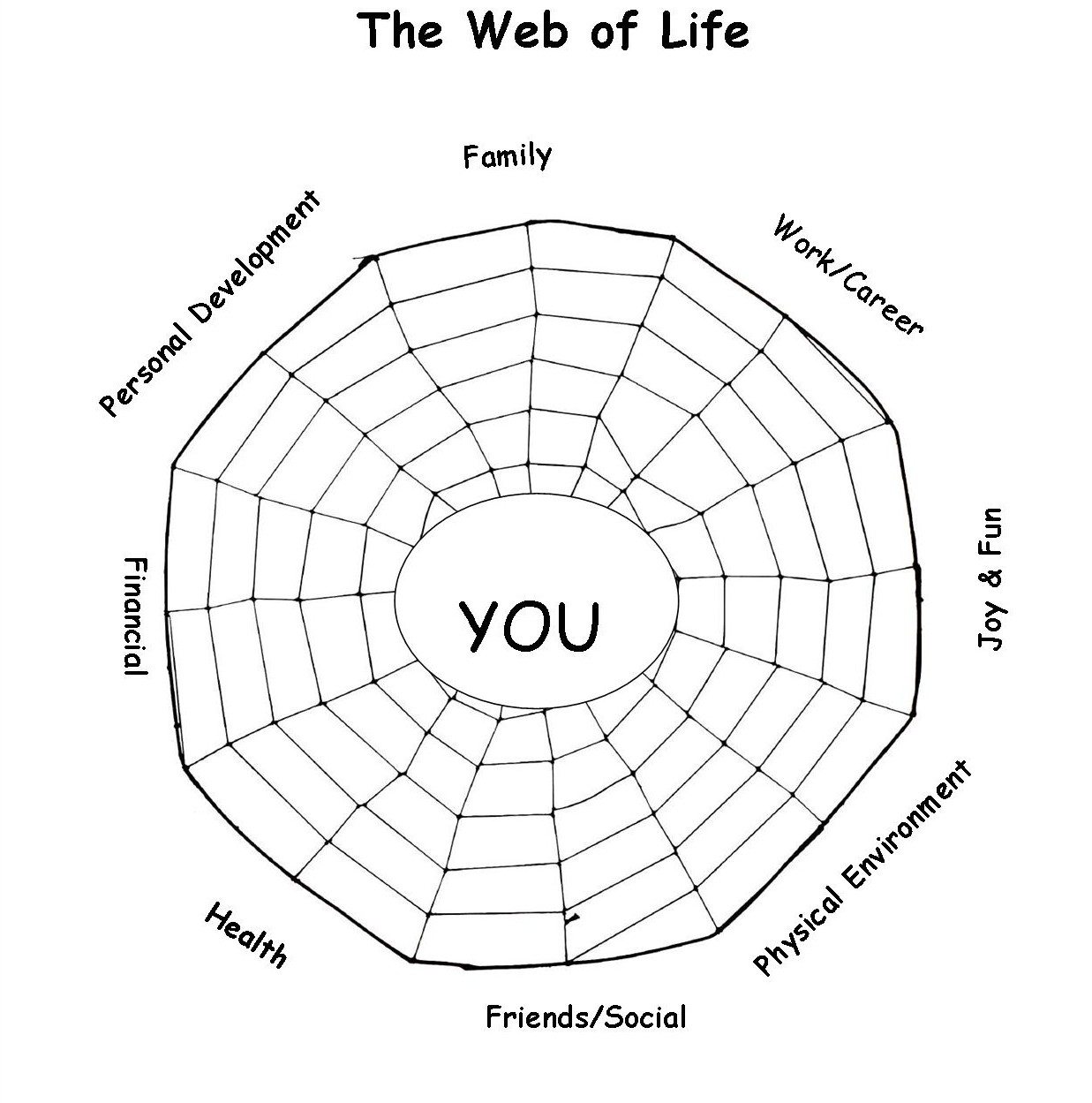
The Web of Life
It’s truly remarkable. I wake up at 6:30 each morning now after sleeping seven hours. I enjoy coffee and ponder how I should spend my day. I don’t plan my day around my level of pain and the density of my brain fog. I look forward to the daily stroll in the pasture, watching the dogs run, sniff, and pester Amigo. I stroke Amigo’s nose when he takes a break from this grass and greets me.
Last week, I started substitute teaching again. Last year, I tried to help out in the school where my husband teaches but was too exhausted after one day. While I don’t regret leaving my career as a school counselor for coaching, I do miss interacting with kids. I know many of the students and substituting is a great way to fill my need of teen time. This weekend is prom and one of my spousal duties includes being my husband’s date for the evening. I look forward to going this year and dancing with my date.
I review my Web of Life and consider areas that need addressing and strengthening. I
Amigo takes a break from grazing to check out the scenery.
look at my web differently now. Health takes on a different meaning, for I no longer assess which part of my body requires greatest attention. I also look at personal development with fresh eyes and open mind. I spend more time exploring my spirituality. Joy & fun plans are now made without fear of cancellation due to illness.
I go to bed without fear of tossing and turning. I started writing a gratitude journal and document three things that I am grateful for each day. I indulge in new dreams and strive to shed old burdens.
I know the phantom inside me exists and while it sleeps soundly now, I realize it may awaken again. But I relish each pain-free day and look at life with a new sense of purpose.
Live more joyfully despite chronic illness.
Contact me atlaurawebb@lbwebbcoach.com and let’s schedule time to chat!
I returned home from Alabama a week ago. I never thought much of ’Bama’ before though thrilled to mark it off as the 47th state that I visited. Before landing in Birmingham, my knowledge of Alabama was limited to its ignoble role in civil rights history and the crimson tide at University of Alabama. Now I know that U. of Alabama is in Tuscaloosa (and its a beautiful campus). I know tall
Evergreen forests blanket Alabama’s landscape
evergreen trees blanket the hilly landscape. And I discovered hope for a healthier life in Alabama.
While not yet fully recovered from my surgery, I notice major changes in my body. My headaches are gone. I have not experienced phantom stabbing pain since I left the hospital in Alabama nor have I felt constant aching in joints. I can’t say that I’m clear-headed as I’m still taking pain medicine but I don’t feel like I’m in a fog either. As for sleep, I think that I am still recovering from the surgery and travel, but I’m hopeful (yes, truly full of hope!) that my sleep patterns are improving.
The biggest challenge now is my diet. For 3 months, I am forbidden to eat bread and meat, not even chicken or fish, until my esophagus heals completely. For now, I’m keeping gluten-free. I wish I could say that I’m starting with a clean plate and healthy eating but I don’t write fiction. The gallons of ice cream in my freezer likely will keep me from losing the 30 pounds I’m expected to lose.
Yes, I am hopeful. I am becoming a believer in Dr. Pridgen and his medical wisdom. And my confidence is growing that the FDA will approve the treatment later this year (yes, in 2013) and real help will finally become available to the tens of thousands of fibromyalgia and chronic fatigue sufferers.
Yesterday, my mom and I met with Dr. William Pridgen, Dr. P., about the treatment for fibromyalgia and chronic fatigue syndrome. The journey for Dr. P began when he sought successful treatment for patients he saw as a gastroenterologist. Suffering from more symptoms than GERD, and alternating diarrhea and constipation, Dr. P. tried regimens of a combination of antivirals and found that medications treating herpes simplex type 1 proved highly successful.
As I discussed in my earlier posting, I contacted Dr. P. and am in Tuscaloosa this week. In our meeting yesterday, I learned a bit about the biology about the herpes virus Dr. P believes to lives in the stomach. I shared more of my history. I found Dr. P not only knowledgeable and caring but funny, approachable, and surrounded by a wonderful staff. I never felt rushed and just another patient on the assembly line. I allowed myself a glimmer of hope at last.
After our meeting, I felt overwhelmed with the possibility that my health may change – truly change. Fibromyalgia and CFS have been a part of my life for longer than not. I allow myself moments to dream about exercise without fear of crashing, traveling without planning post-travel crash, less brain fog. I’m sure my keys will always walk away from where I leave them no matter how healthy and clear-headed I may become.
Tomorrow, I have a procedure that repairs my esophagus due to high volume acid from my stomach. Apparently, the esophagus is the second part of the body damaged from fibromyalgia. The gallbladder is the first to go and I thought the surgeon who removed mine several years ago was a hack since my symptoms continued. Dr. P assures me the organ had likely stopped functioning.
Post-surgery, I begin new medications, mostly antivirals, intended to put the nasty herpes virus back to a permanent coma. The process is not immediate but the results are astonishingly successful. In fact, there is a study for this treatment in 11 centers around the country beginning in March that the FDA is watching closely. The plan is for 2013 the year a truly viable treatment becomes available, with FDA approval, for successfully treating fibromyalgia and chronic fatigue syndrome!
Can you imagine?! No more trial and error of medications. No more frustrations that doctors can’t really help and only support groups and bloggers understand. Hope for better health for sufferers of fibromyalgia and chronic fatigue syndrome may soon become viable.
While I am a dreamer, my dreams are for goals and achievements that I can make happen. When it comes to my health, I have never held out hope for a healthy life. After all, when diagnosed with a chronic illness, the very term means forever illness. Don’t misunderstand, I have a wonderful life and work hard at finding ways to better manage my life as well as improving the quality of life for others living with chronic illness. It is sometimes challenging but life is a challenge for everyone. “It is what it is,” I often say. But I never dared hope that the CFS/ME and fibromyalgia that’s raged inside me for so long that I no longer know what good health means, may actually be tamed.
It all started when my mother-in-law called me a couple of weeks ago and read an article in the Abilene Reporter about a research study taking place at the University of Alabama on a possible link between the herpes simplex type 1 virus and fibromyalgia as well as a potentially successful treatment. I asked my husband’s mom to mail me the article and forgot all about it until I received it a week ago.
After reading the article, I went online and began researching the study, the names mentioned in the article, and decided to email one of the researchers. The next day, I made another contact and the physician responded to my email immediately. After several exchanges, he believed that my case warranted the treatment. Tomorrow, I travel to Tuscaloosa for a week.
As a pragmatist, I shy away from miracle cures and guarantees. This opportunity feels different for several reasons. First, U. of Alabama is not the only place where research of the link between herpes and fibromyalgia as well as CFS/ME are taking place. Second, the trial study is in its second phase towards gaining FDA approval. This is not a potion, rather existing medical treatments that the physician has found successful when treating his patients with fibromyalgia. Third, I am not part of the study so I don’t have to worry about getting a placebo. Finally, my insurance covers the treatment.
I don’t even know if hope is the way I feel yet. Accomplishing all the steps so I don’t miss my plane seems monumental. Doing laundry; going to the store so my husband and pets have enough to eat all week; printing directions and boarding passes; and packing is exhausting especially when the body already feel cruddy. But, “you gotta do what you gotta do,” another favorite saying. Perhaps I’ll know what hope feels like once I arrive, talk with the physician, and have a full understanding of what’s coming.
I dare not think that my life may change, that my intestines may normalize the phantom inside that brings sharp pains disappears or the other aches subside. I refuse to dream of sleeping throughout the night and waking up energized. Even if one or two symptoms subside, the trip will be worthwhile. If nothing else, my mom is joining me and we’ll spend quality time together andAlabama is one of the few states that I haven’t visited so I can mark it off my list.
“Ow!” I yelp as I leaned on my wrist a bit too heavily.
“What did you do now?”, my husband asked.
“Nothing. It’s just the phantom is in my wrist today.”
This is a common exchange between me and my husband. He seems to think that I’m a klutz. Just because he’s seen me stub and break a couple of toes and observed countless bruises on my legs from bumping into things doesn’t mean all my pain is the result of some self-induced injury.
I call these mystery pains, ‘the phantom’, as they mysteriously attack and leave various joints without warning. These are the traveling pains that are sharp and cause weakness to the joints. If the pain is in my ankle, I am unable to walk. If it moves to my wrist, I cannot open a jar or bend down to kiss my husband. In about 10 minutes, the attacker is gone and there are no lingering effects.
Sometimes I wish that there was evidence that these illegal immigrants invaded my body. There is no joint swelling and test results are negative when I visit the doctor in acute pain. It confounds me every time that my symptoms rule out other diseases and rule in fibromyalgia and chronic fatigue syndrome. I feel relief that rheumatoid arthritis, lupus, or another serious more life threatening illness tests return negative but frustrated that there is never a definitive answer only ruled out diseases. Furthermore, the elusiveness of these dual illnesses admittedly cause emotional setbacks at times.
Then, my husband says something to make me smile or I watch my dogs interact with each other or with the cat and my low mood transforms to joy at the simple pleasures that life offers. The phantom slips back into hiding for a bit. Yeah, I have discomforts in life but they are nothing compared to the simple moments that bring me joy. I’m so lucky.
Homer and Zoe, who now romps in eternal fields and streams, made me laugh daily with their wrestling moves.
Luna and Homer at play at the lake.
My hubby being silly on face time with grand twins. I wonder if this cowboy would kill me if he knew I posted this but that’s what he gets for not reading my blog.
I bet I will get a number of hits from people looking for their big break in starting the latest fashion trend but will stop reading this as soon as they learn what I blog about. The truth is that those of us with chronic illness find the demands of looking fashionable in high heels, tight-fitting jeans and diving necklines too painful.
Long before diagnosis, buttoned slacks and skirts were difficult for me to tolerate. As a professional, I tried to look sharp but when possible, I hid in my office with my jacket off, skirt unbuttoned, and blouse untucked. In some cases, I admit that my waistline grew, but more often, the clothes didn’t feel tight as much as imprisoning as I imagine a straight jacket might feel. The minute I came home, the clothes went flying off and sweats were put on. I could breathe again. I managed to find some designers passed as presentable in the business world. I found outfits by Eileen Fisher and the store Chico’s kind to those of us with tender nerves but most cared little about comfort.
I could no longer bear panty hose, for the confinement of my legs proved unbearable. In the summer, I could get away with tanned legs and open toed shoes but winters were more of a challenge. I often wore pant coordinates and suits but I like the freedom of dresses and skirts. Midi and maxi lengthed skirts allowed me to get away with knee highs. Can you imagine the horror that Stacey and Clinton of that cable tv show What not to Wear might experience if they ever learned of my fashion style? If an ambush makeover was ever attempted on me, I’m certain they’d give up.
I am fortunate now that style is not as important when working from my home in rural Texas. Drawstring sweatpants and XL t-shirts are not offensive to the computer or telephone. I don’t have to impress anyone at the grocery store or bank and I have found blue jeans and other casual clothes that are comfortable.
But I do think the fashion gurus need to give those of us who have tender nerves and are often in pain a break. High heels, zippers, buttons, and ties are not conducive to our bodies. Since there are millions of us out there struggling to make it through the day, it sure would be nice if someone would keep those of us with painful joints, muscles, and nerves in mind when you create your next fashion trend.
I have just completed my first newsletter for LB Webb Coach! To receive a free copy, simply visit my website (link below) and complete the very brief sign-up form.
Unfortunately, wordpress.com does not let me to add a form on my blog though wordpress.org does. I just learned today that there are 2 different sites – who knew??
The newsletter provides information about coaching people with chronic illness as well as useful tips and suggestions to ease the pain suffering that intrudes on many of our daily lives.
I hope you can find a few moments to read my newsletter and find the info useful. I welcome comments and suggestions for topics on future articles.
Imagine changing your way of life by improving the function of your brain. Mind & body expert and bestselling author, Deepak Chopra, claims we can do just that in an article I read recently on the CNN website. Apparently, we can make our brains work better simply by thinking we can improve them and the best way for us to relate to our brain is to ‘inspire it’.
According to Chopra, “thinking your brain into better functioning is the most efficient way to improve it.
The ways Chopra suggests improving brain function are also important aspects of living better despite chronic illness & pain that I coach my clients. The brain is a powerful muscle requiring exercise and a bit of TLC for best results. By changing how we think of ourselves, new adventures and opportunities await.
Below is an abbreviated list on how you can inspire your brain to work better:
Manage stress
Avoid dull routines
Do something creative everyday
Read something inspirational everyday
Take time daily to relax, meditate, self-reflect
Deal with negative emotions such as anxiety and anger
Love and Be loved – it’s a worthwhile risk
Take some time to notice and appreciate nature daily
Follow a personal vision – how do you want to live your life?
Participate in at least one activity that fulfills
Get involved in a cause that is bigger than you.
The article continues with thoughts in your brain that you should ignore. Not surprisingly, the thoughts to ignore are: passivity such as letting life take care of itself; inflexibility in daily routines and opinions; and allowing feelings of stress, anger or anxiety get the best of you.
For many of us, inspiring our brain may seem like an overwhelming task. But with encouragement and patience, I believe everyone can do it. I also think it especially important for sufferers of chronic illness to work on inspiring their brain, for it is through these activities that living better becomes possible.